Water conservation, climate reality,
and why smart storage matters now
As the Western Cape heads into the winter months, the conversation around water shifts, or at least, it should. Winter has traditionally been our period of relief: the season when dams refill, soils recharge and gardens recover. But climate change has quietly, steadily altered that rhythm. Rainfall still comes, yes, but less predictably, less evenly, and often less usefully than before.
Long‑term forecasts from the South African Weather Service continue to point to warmer winters and below‑average rainfall across much of the Western Cape, including Cape Town and surrounding regions. At the same time, drought cycles are becoming more frequent and more severe, placing permanent pressure on municipal supply, groundwater systems and outdoor water use. These realities demand a different approach to landscaping, one that treats water not as an endless service, but as a resource that must be captured, stored, and used responsibly
Not All Suburbs Are Created Equal
One of the biggest misunderstandings in residential landscaping is the assumption that “Cape Town” experiences water uniformly. In reality, microclimates matter.
Areas such as Newlands and Constantia, positioned along the eastern slopes of Table Mountain, consistently receive higher levels of orographic rainfall throughout the year. Long‑term data shows annual rainfall in these areas to be significantly higher than in many coastal and wind‑exposed suburbs. This makes extensive rainwater harvesting systems, combined with well‑designed storage tanks and booster pumps, not only feasible but highly effective.
By contrast, suburbs such as Fresnaye and Camps Bay, particularly on rain‑shadowed slopes, receive markedly less reliable rainfall. In these locations, boreholes and alternative water sources become essential, provided they are installed and managed in line with City of Cape Town water by‑laws and national groundwater regulations.
For BEST Landscaping, this distinction informs everything, from irrigation design to plant selection, to long‑term maintenance planning. Water strategy must be site‑specific, lawful and sustainable. There is no one‑size‑fits‑all solution.
Landscape Style Must Follow Water Reality
Water availability directly influences landscape design language.
Higher‑rainfall areas such as Newlands and Constantia can support lusher, subtropical or European‑inspired cold‑temperate gardens, where structural planting, layered canopies and higher biomass make sense but only when paired with responsible harvesting and storage.
Drier areas demand a different aesthetic: water‑wise, climate‑appropriate gardens that prioritise deep‑rooted plants, improved soil structure, mulching, and efficient irrigation. These gardens are not sparse or austere; when done well, they are rich, textured, and resilient, designed to thrive within natural limits rather than fight them.
At BEST Landscaping, water‑wise design is not a trend response; it is an ethical baseline.
Storing Water for the Seasons Ahead: The Bathurst Farm Project
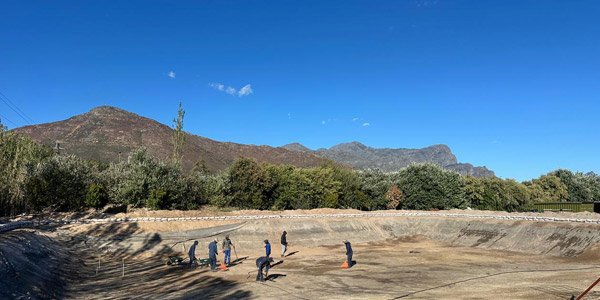
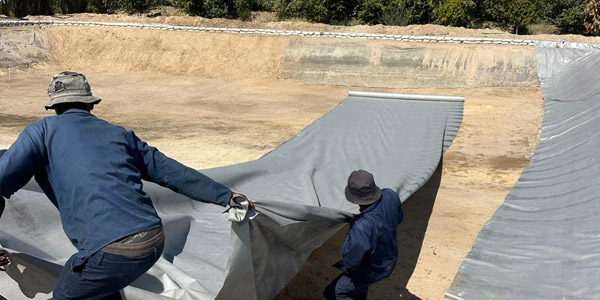
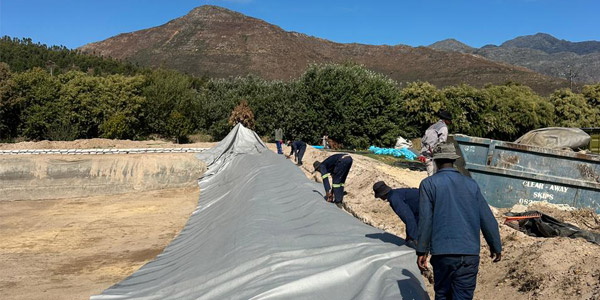
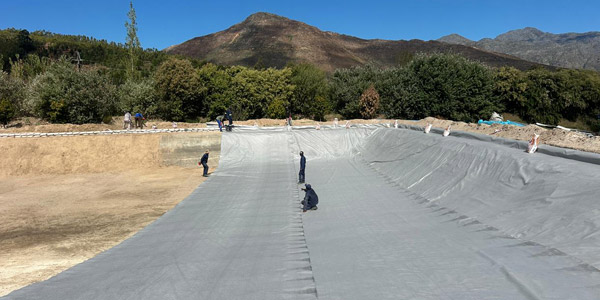
For our Bathurst Farm client in Franschhoek, BEST Landscaping is taking water stewardship to scale. A large dam system with a capacity of approximately three million litres is currently under development, designed to capture winter rainfall while also storing borehole water for use during dry cycles.
To ensure long‑term efficiency and environmental responsibility, the project is being lined with a top‑of‑the‑range EPDM geomembrane, specifically the Carlisle EPDM liner. EPDM is widely regarded as one of the most durable water‑containment materials available, offering:
- Exceptional elasticity and stretch, allowing it to adapt to ground movement.
- Proven UV resistance exceeding 20 years in exposed conditions.
- High resistance to cracking, puncturing and environmental degradation.
- The ability to be repaired or patched, much like a bicycle tube, if ever required.
Unlike rigid or brittle alternatives, EPDM maintains performance across temperature extremes and irregular dam profiles, making it ideal for large‑scale agricultural and landscape storage. This dam is not simply a backup supply, it is a proactive buffer against climate volatility, ensuring water is available when landscapes need it most, not only when the clouds cooperate.
Climate Change Demands a New Normal
What we are experiencing is not a temporary fluctuation. Climate data points to a new normal, one where rainfall arrives unpredictably, storms are more intense, and dry periods extend longer than historical averages.
For the landscaping industry, this means moving beyond compliance and into leadership.
Responsible water conservation is not just about reducing usage; it is about designing systems that future‑proof landscapes. Capturing rain when it falls, storing alternative sources lawfully, building soil health to retain moisture, and matching plant palettes to real water availability are no longer optional best practices, they are professional obligations.
BESTS’s Position
At BEST Landscaping, every design and every maintenance decision is made with the understanding that water is finite. We work deliberately within regulations, we invest in infrastructure that lasts decades (not seasons), and we design landscapes that respect both place and climate.
Sustainable landscapes are not defined by what they look like in their first year, but by how they perform ten, fifteen, twenty years down the line.
That is the kind of work we are committed to.
If you are planning a new garden, upgrading an existing landscape, or rethinking how your property uses water, now is the moment to design with intent, not just for the season ahead, but for the decades that follow.
BEST Landscaping partners with property owners, estates and developers who understand that responsible water use, resilient infrastructure and climate‑appropriate design are no longer optional. From rainwater harvesting and borehole integration to intelligent storage, soil improvement and water‑wise plant palettes, we help build landscapes that can adapt, endure and perform under real Western Cape conditions.
If you’re ready to move beyond short‑term fixes and invest in a landscape designed for the long haul, we’d welcome the conversation. Let’s design a landscape that works even when the rains don’t.

Meet Asiphe Mtsuma
A Gift to the Garden at Bathurst Farm
Meet Asiphe Mtsuma, our resident green guardian at Bathurst Farm and with a name that means “provide for us,” “God has given,” or “gift” in isiXhosa, she fits her role more perfectly than any of us could script.
Every day, Asiphe brings that spirit of provision and care into the garden, nurturing vegetables, herbs, and ornamentals with the same patience and attentiveness her name reflects. From composting and soil feeding to pruning, pest patrol, and keeping watering systems running smoothly, she’s the steady heartbeat behind a garden that stays productive, healthy, and beautifully tended.
What she loves most? Watching the space respond to consistent care, seeing the garden flourish over time, exactly the kind of blessing her name speaks into.
- How did your approach to horticulture change as you moved from a conservation garden to a public garden, and then into the private sector?As a horticulturalist, each environment shaped my thinking in different ways. In a conservation setting, the focus was firmly on tradition, protocols and long‑term plant preservation, everything was done carefully, methodically, and with very little room for experimentation. Moving into a public garden broadened my perspective. Suddenly, plants weren’t just about survival and collection value; they were also about visitor experience, education, and biodiversity. In the private sector, the emphasis shifted again. Efficiency, innovation and client satisfaction became central, while still maintaining horticultural integrity. Together, these experiences taught me how to balance tradition with creativity, and long‑term care with practical outcomes, a combination that continues to guide my work today.
- What were the biggest challenges in adjusting to the expectations of each workplace, and how did you navigate them?The biggest challenge was learning to shift mindset. In conservation environments, consistency is king and creativity takes a backseat. In public gardens, I had to learn how to explain and share my work with visitors, turning horticulture into a learning experience. In the private sector, horticulture had to align with business realities: budgets, timelines and client expectations. I navigated these shifts by staying curious, asking questions and treating each environment as an opportunity to grow professionally rather than resist change.
- What first drew you to horticulture, and what keeps that passion alive today?My love for horticulture started very simply, with fascination. As a child, I was deeply curious about how plants grow and interact with their environment, and I always dreamed of becoming a plant scientist. Over time, that curiosity grew into a deeper appreciation for the role plants play in food security, environmental health and human wellbeing. What keeps me passionate today is that horticulture is never static. Nature is always changing, always teaching, always offering something new to learn or improve.
- How does working in public gardens differ from the private sector, and what can each learn from the other?Public gardens place a strong emphasis on education, accessibility and community engagement. The focus is often on experience, storytelling and long‑term stewardship rather than efficiency. Private sector horticulture, on the other hand, prioritises results, aesthetics and operational effectiveness. There is real value in both approaches. Public gardens can learn from private‑sector innovation and resource management, while private landscapes benefit greatly from the public sector’s emphasis on biodiversity, sustainability and thinking beyond the short term.
- Be honest; which plant is the drama queen of the garden?Hydrangeas earn that title every time. 😄 They’re famous for looking like they’ve completely given up the moment conditions aren’t perfect. A warm afternoon, slightly dry soil, or a bit too much sun and suddenly they’re flopped over like a full theatrical performance. Thankfully, give them water and shade, and they recover just as dramatically.
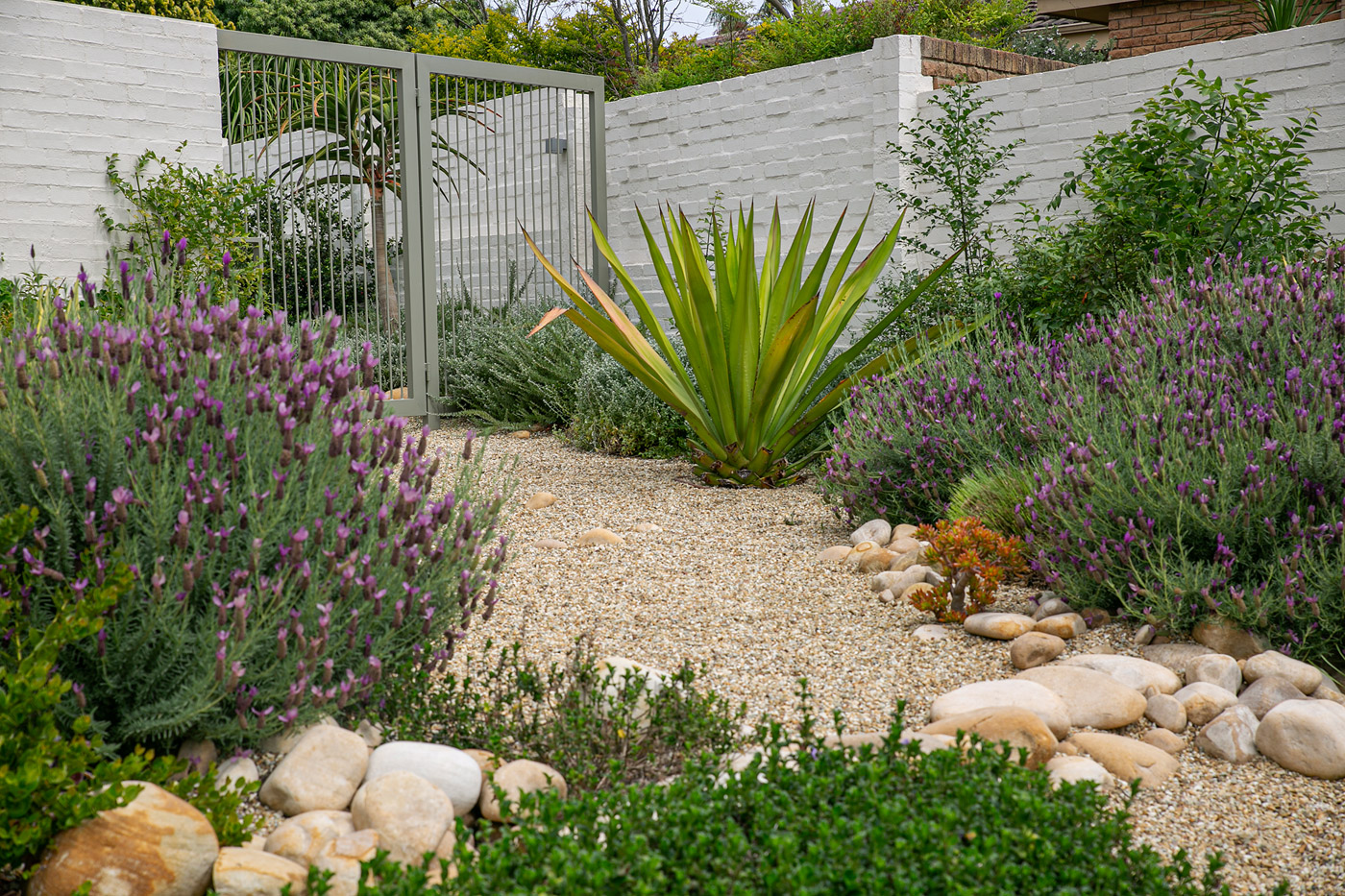
Five Practical Ways to Build a Water‑Smart Garden
You don’t need to overhaul your entire landscape to start using water more responsibly. In many cases, meaningful savings come from how a garden is managed rather than what it looks like. The following principles can be applied incrementally whether you’re refining an established garden or planning changes over time.
- Design for Water Movement, Not Just Watering
Water efficiency isn’t only about how much you apply, it’s about where it goes once it hits the ground. Gardens with poor shaping can shed water downhill before plants benefit, while compacted areas may prevent infiltration altogether. Thoughtful grading, curved beds, and defined planting zones help slow water down, allowing it to soak into soil where it’s needed most.
Tip: If water runs off or pools after irrigation, the problem is design, not dosage.
- Improve Soil Before Increasing Irrigation
Healthy soil is one of the most effective water‑saving tools available. Organic matter improves soil structure, increases moisture retention, and supports deeper root development. Mulching reduces surface evaporation, moderates soil temperature, and protects soil biology.
Tip:Improving soil often delivers greater results than upgrading irrigation hardware.
- Make Storage Part of the System
Water storage works best when it’s integrated into the overall garden plan, not added as an afterthought. Rainwater tanks, underground storage, or dam systems on larger properties allow water to be captured when it’s available and used later under controlled conditions. The goal is to reduce dependence on real‑time supply and create a buffer against dry periods.
Tip: Stored water is most effective when paired with efficient distribution and scheduling.
- Irrigate With Intention, Not Habit
Overwatering is often a timing issue rather than a volume issue. Frequent shallow irrigation encourages weak root systems that rely on constant moisture. Deep, infrequent watering promotes stronger roots and better resilience during heat or dry spells.
Tip: If plants only thrive with daily watering, it’s a sign the system, or planting choice, needs adjustment.
- Think in Lifecycles, Not Seasons
A garden’s true sustainability reveals itself over time. Fast‑growing, high‑water solutions may deliver instant impact but often create long‑term maintenance and water demands. Landscape decisions should anticipate how plants mature, how climates shift, and how water availability may change over the next decade or more.
Tip:Ask whether today’s solution still makes sense ten years from now, not just this summer.
The Bottom Line
Water‑smart gardens aren’t defined by sacrifice they’re defined by foresight.
With thoughtful design, healthier soil, integrated storage and intentional watering, it’s entirely possible to create landscapes that are both visually rewarding and environmentally responsible. Small changes, applied consistently, add up.